Pearson Edexcel · GCSE · History
Course version: 1HI0 · Version from Sept 2016
C1700–c1900: Crime and punishment in eighteenth- and nineteenth- century…
Full specification wording
Option 10: c1700–c1900: Crime and punishment in eighteenth- and nineteenth- century Britain - 3 Case studies ● Pentonville prison in the mid nineteenth century: reasons for its construction; the strengths and weaknesses of the separate system in operation.: Key individual: Robert Peel – his contribution to penal reform and to the development of the Metropolitan Police Force.
Robert Peel played a pivotal role in 19th-century law enforcement and penal reform.
Checked against the Pearson Edexcel 1HI0 specification (opens in a new tab) on .
- 4 key terms
Study notes
From the checked teaching notes for this specification point.
The idea
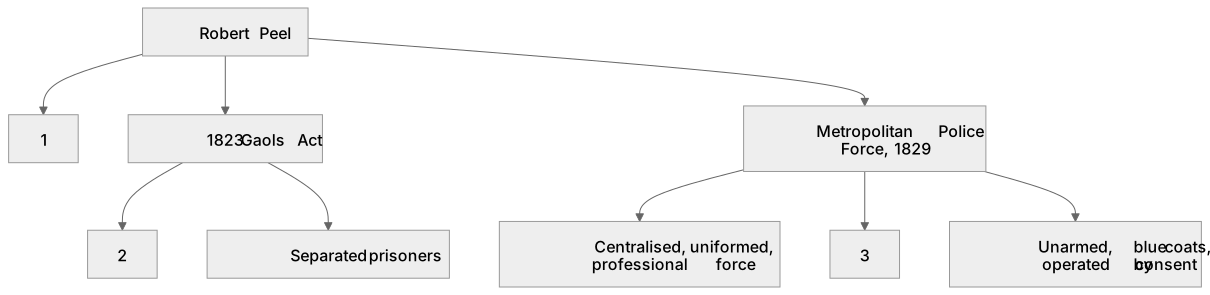
Robert Peel played a pivotal role in 19th-century law enforcement and penal reform. As Home Secretary, he significantly reduced the number of capital offences, effectively dismantling the Bloody Code, and introduced the 1823 Gaols Act to improve prison conditions by paying gaolers and separating prisoners. His most famous contribution was the creation of the Metropolitan Police Force in 1829. Peel established a centralised, uniformed, and professional police force aimed at preventing crime rather than just reacting to it. He overcame public fears of a military-style police state by ensuring the 'Bobbies' were unarmed, wore blue coats to distinguish them from the army, and operated by consent, fundamentally changing British policing.
What earns the marks
- Describe Peel's role in reducing the number of crimes punishable by death, contributing to the end of the Bloody Code.
- Explain the significance of the 1823 Gaols Act in standardising prison conditions and paying gaolers.
- Detail the establishment of the Metropolitan Police Force in 1829 and its primary aim of crime prevention.
- Explain how Peel designed the police force to gain public trust, such as using blue uniforms to avoid comparison with the red-coated army.
- Evaluate Peel's overall impact on the transition from amateur to professional law enforcement.
Common mistakes and how to put them right
Stating Peel invented the concept of policing.
Put it right: He established the first professional, centralised police force in London, building on earlier local efforts like the Bow Street Runners.
Believing the Metropolitan Police was immediately popular.
Put it right: They faced significant initial opposition and suspicion from the public who feared a loss of liberty.
Confusing Peel's prison reforms with those of Howard or Fry.
Put it right: Peel used his political power as Home Secretary to pass legislation (1823 Gaols Act), whereas Howard and Fry were campaigners.
Exam tips
- Use the term 'policing by consent' when explaining the principles behind Peel's Metropolitan Police.
- Link Peel's penal reforms (reducing capital crimes) to his police reforms (creating a force to catch criminals, making harsh deterrents less necessary).
- Remember that Peel's 1829 Police Act initially only applied to London, not the whole country.
Try the lesson
The start of the Option 10: c1700–c1900: Crime and punishment in eighteenth- and nineteenth- century Britain - 3 Case studies ● Pentonville prison in the mid nineteenth century: reasons for its construction; the strengths and weaknesses of the separate system in operation.: Key individual: Robert Peel – his contribution to penal reform and to the development of the Metropolitan Police Force. lesson, made from checked teaching notes for this specification point.
Have a go first
What major law enforcement institution did Robert Peel establish in 1829?
Listen
Robert Peel played a pivotal role in 19th-century law enforcement and penal reform. As Home Secretary, he significantly reduced the number of capital offences, effectively dismantling the Bloody Code, and introduced the 1823 Gaols Act to improve prison conditions by paying gaolers and separating prisoners. His most famous contribution was the creation of the Metropolitan Police Force in 1829. Peel established a centralised, uniformed, and professional police force aimed at preventing crime rather than just reacting to it. He overcame public fears of a military-style police state by ensuring the 'Bobbies' were unarmed, wore blue coats to distinguish them from the army, and operated by consent, fundamentally changing British policing. A strong answer earns marks for these points. Describe Peel's role in reducing the number of crimes punishable by death, contributing to the end of the Bloody Code. Explain the significance of the 1823 Gaols Act in standardising prison conditions and paying gaolers. Detail the establishment of the Metropolitan Police Force in 1829 and its primary aim of crime prevention. Explain how Peel designed the police force to gain public trust, such as using blue uniforms to avoid comparison with the red-coated army. A common slip: Stating Peel invented the concept of policing. Instead, he established the first professional, centralised police force in London, building on earlier local efforts like the Bow Street Runners. Exam tip: Use the term 'policing by consent' when explaining the principles behind Peel's Metropolitan Police.
See it

Key words
Say what each word means before you turn the card.
Robert Peel
Try answering aloud or in your head before turning the card.
Metropolitan Police Force
Try answering aloud or in your head before turning the card.
policing by consent
Try answering aloud or in your head before turning the card.
1823 Gaols Act
Try answering aloud or in your head before turning the card.
See every definition
- Robert Peel
- Key individual whose contribution to penal reform and to the development of the Metropolitan Police Force is studied.
- Metropolitan Police Force
- Centralised, uniformed and professional police force created in 1829, aimed at preventing crime rather than just reacting to it.
- policing by consent
- Principle behind the Metropolitan Police in which the force operated with the agreement of the public.
- 1823 Gaols Act
- Introduced to improve prison conditions by paying gaolers and separating prisoners.
Label the diagram
Some boxes have lost their names. Pick the right name for each number.
1Box 1
2Box 2
3Box 3
There is more to this lesson
The full lesson goes on to check your understanding and help you earn the marks. Create a free account to carry on, with your progress saved.
A week of Premium from your first lesson · Then the free plan continues · No card, no charge
Test your understanding of Option 10: c1700–c1900: Crime and punishment in eighteenth- and nineteenth- century Britain - 3 Case studies ● Pentonville prison in the mid nineteenth century: reasons for its construction; the strengths and weaknesses of the separate system in operation.: Key individual: Robert Peel – his contribution to penal reform and to the development of the Metropolitan Police Force.
Active recall beats re-reading. Take an instant quiz now to test what you’ve learned and lock it into long-term memory.
A week of Premium from your first lesson · Then the free plan continues · No card, no charge